Sunday, June 2, 2013

Rabbit-proof fence


While traveling for three months in Australia, I dug into the culture and watched the movie "Rabbit-Proof Fence." It's the dramatic true story of three aboriginal girls who followed a fence that had been erected in Western Australia to keep non-native rabbits on one the east side out of the pastoral grounds in the west.

While I am not facing ultimate destruction of every living thing in my country, it certainly is starting to feel that way.

I started to get this feeling when two weeks ago something ate all of the marigolds I planted in my community garden plot. "Marigolds?" I thought they repelled things, and were not interesting food for anything. I replanted them and this time stretched row cover over them and fixed in place with 6 inch ground staples. To my horror, the other day I found that something had pulled the ground staples out and ate all the marigolds.

I also discovered this same creature ate an egg plant and a pepper plant! "A pepper plant?" This is the first time I've had any plant damage from anything but insects. It think it's fair to say the mammals have found our community garden.

So Saturday morning before going to my garden to finish planting and doing a little weeding, I stopped at the hardware store and purchased fencing and fence posts. You have no idea how much this pains me. The aesthetics alone I find distasteful, the inconvenience even more so. Then there's the maintenance, the sagging, the rusting, etc.


Everything in my garden is once again covered in row cover, but has previously discovered this may not help at all. But I ran out of time on Saturday morning and so the fence posts and chicken wire remain in their original packaging.

I know that if I don't assemble this I will return to my garden regularly and cry silently or yell loudly if no one is around. I also know each time I return after putting the fence up I will feel like I gave in to some four-legged creature that hasn't given me the courtesy of a thank you note.

New photos as the fence goes up.

Monday, May 27, 2013

Succession planning a small garden


Ever since I called myself a “lazy gardener” in my other blog posts on raised beds, not stepping on plants and mulch, I’ve been wondering if the word “lazy” comes from the French “laissez faire,” or “deliberate abstention from direction or interference…” In my case, the less I have to interfere in my garden, the more time I have to prepare and eat the food from it.

Here is another areas where I significantly more vegetables in my small community garden plot.

Succession planting
Some vegetables are harvested mid-summer. Think onions and garlic. Succession planting can make sure your valuable garden space doesn’t go to waste for the rest of the season.

  • Create a planting scheduled so you don’t forget to get those seeds in on time. 
  • Watch the maturity time on seed packets. It’s no fun planting 50-day beets 30 days before the first frost. 
  • Plant fast-growing plants near slower growing ones. For example, plant garlic (fast) near peppers (slower) - after your mid-July garlic harvest, the peppers will fill out and take up the empty space.
  • In late July or early August, plant beets, carrots or radishes, all of which will grow before the first frost hits them. 
  • In September, plant lettuce to harvest later in the month. It likes cooler weather.
  • In October, plant garlic for harvest next season.
Autumn-planted garlic is harvested in July. I will put in a crop of lettuce or short-season carrots for the remainder of the season.
50-day beets were planted in mid-April to be harvested in summer. Edamame (soybeans with edible pods) go in next, and later in the season I'll plant a 240-day carrot which will be harvested next summer.


Thursday, May 23, 2013

Flea beetles and rabbits

Just when I thought I was safe from frost and my plants are over the shock of being in the full sun, I think it's safe to say the flea beetles have found our community garden and the rabbits have found my plot in particular.

Thanks to a blog post from The Mifflin Street Planthouse that mentioned she'd have a few extra plants for those whose kale got hit by flea beetles, I visited my community plot today. The kale, under a floating row cover, hadn't been hit by beetles.

Kale looking pretty good under floating row cover. There was some insect damage, but not horrible (yet).
But there was nothing left of my eggplant and ground cherry plants. Seriously, I just planted them last week!

Then I looked and saw that a pepper stem, my largest plant, had a big toothy gouge in it. Pulled the plant, it was a goner.

Finally, an entire row of marigolds had been mowed to the ground. Marigolds? I planted them to keep the rabbits out! I'm seriously considering a low fence around my beds.

Poor marigold didn't stand a chance to the killer rabbits.
Fortunately, I had just received 50 feet of row cover and a bunch of fabric ground staples, so I started to cut pieces to individually wrap everything.

I think I found a nice way to manage it. I heavily mulch my garden, but the row cover is unsealed around the edges, even with lots of ground staples. I pulled the mulch away, stapled the cover to the dirt and then replaced the hay mulch. I'm hoping this will discourage more salad time in my garden.

Now, where to find the particular varieties I started in my basement seven weeks ago???

I row covered everything, even the tomatoes and marigolds. There is a lot of "blousiness" left for the plant to grow into. I'll just have to get it off and the cage on before it outgrows a cage.

Sunday, May 19, 2013

The Lazy Gardener mulches - heavily


A heavy layer of leaf or seedless hay mulch is very good for your garden. Heavy means a good two inches of hay mulch “slabs,” or a good inch of partially rotted leaves. Mulch is the organic gardener’s friend too:
• Maintains consistent moisture (less watering)
• Reduces weeds (less weeding)
• Reduces erosion (good for the soil)
• Breaks down, adding fertility (also good for the soil)


This is how thick I apply marsh hay mulch. Compared to my neighboring plots (look just behind my plot) I have no weeds and I haven't weeded yet this spring!)

Friday, May 17, 2013

The Lazy Gardener doesn't step on plants


When giving a tour of my vegetable patch, I call myself a lazy gardener. It usually gets a laugh, but more important, it gets people’s attention. Here is one of my top tips to decrease work, increase fun and grow more vegetables. 


Don’t step on your plants. One of the reasons I like garden beds is it not only keeps weeds out, they also help to keep my size 9’s out of my garden. If you’ve worked hard to build loose soil, the last thing you want to do is compact it. Trodding too close can:
  • Damage fragile roots
  • Compact soil, reducing water penetration
  • Break off branches, flowers or fruit
The Gadsden flag is a historical American flag with a yellow field depicting a snake coiled and ready to strike. Positioned below the snake are the words "Don't tread on me". The flag was designed by and is named after American general and statesman Christopher Gadsden. It was also used by the Continental Marines as an early motto flag, 


Wednesday, May 15, 2013

The Lazy Gardener lies in raised beds


When giving a tour of my vegetable patch, I call myself a lazy gardener. It usually gets a laugh, but more important, it gets people’s attention. Here is one of my top tips to decrease work, increase fun and grow more vegetables.

Raised beds. I like raised garden beds, and they can be simple or complex, all serve the same purpose. Garden beds can be reinforced (made of scrap lumber six to eight inches tall), or simply unreinforced (mounded up soil). Beds can be built before planting or after harvest (for the next season). 
These are the raised beds I grew up with. The art deco carpeting was  a later innovation. 
Some benefits include:
  • Easy access for planting, weeding and harvest
  • Creates a physical barrier so you aren’t tempted to trod on plants or compress soil
  • Soil amendments such as compost and mulch stay in the garden and out of the path where not needed
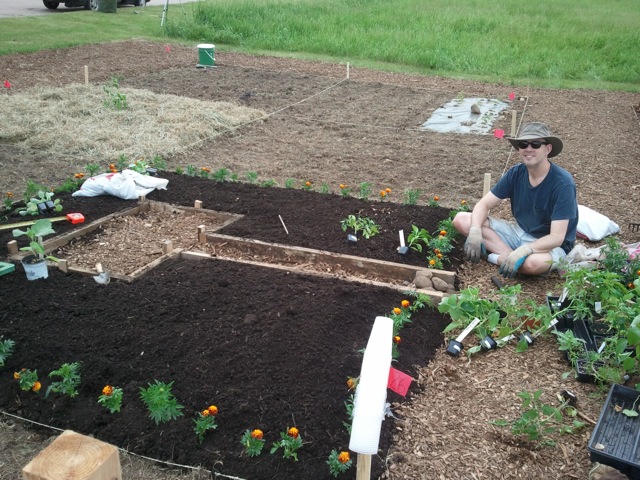
This is the "keyhole" design for my 10x10 garden. Fewer square footage for paths is more for vegetables!


Monday, May 13, 2013

Worms after the rain

I visited my community garden plot shortly after it stopped raining. As I drove to the garden, I saw hundreds, if not thousands, of worms on the road pavement. I felt bad for them, it was a cold morning and they were getting squished by countless cars. 

As I stepped out of my car, I looked down and there was a big nightcrawler. I went to the garden and found a small bucket, and started following the curb and gutter along and then past the garden. It was littered with slow moving but not dead or squashed worms. I picked one up and dropped it into the bucket. 

Then another, and another.

It's fairly compelling to pick them up - and keep picking them up. There's always one more just a few feet up, and another a few feet further. I had limited time, so I when I arrived at an intersection I turned around and returned on the other side. Here's what I found.

Well-worn worm trails in the sand and small gravel.

"March of the Penguins" got nothing on these slow-moving creatures that were desperate to get out of the approaching (and deadly) sun.


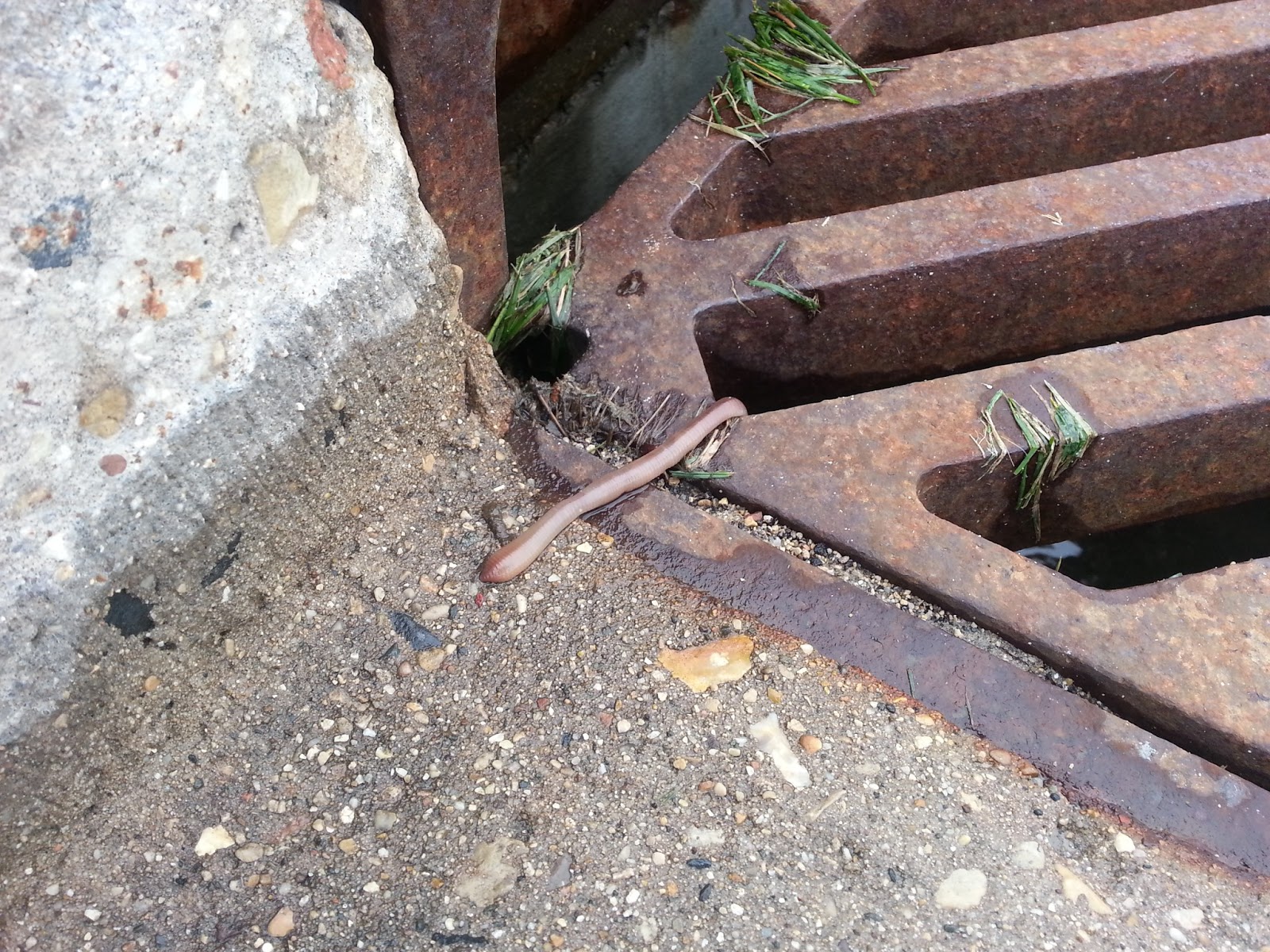
Some of the night-crawlers found escape in pavement cracks like this one, but many other worms were trying to escape to the soil through cracks far smaller than the worms.


I promise this was not a staged photo. "Noooo," I pleaded with the nightcrawler, "Don't jump." Fortunately I was faster than he/she was.
A nice bucket full of worms and nightcrawlers.


I dropped handfulls of worms in each of my garden beds, and covered them with mulch. The mulch would protect them from the sun and keep them moist. Hopefully they'll stay in my garden.