

Thursday, April 23, 2015


Wednesday, April 22, 2015
How to build community: plant flowers
 Going through the list of items from the "How to build community poster," I knew there would be a couple of easy ones. Today I'll pick "Plant flowers."
 When we installed the orchard I knew the trees and shrubs would eventually flower in spring, bear fruit in fall and add winter interest under the snow. As with most new construction, the orchard started out drab and sparse. When I sowed the groundcover clover seeds, I mixed in a variety of marigold and zinnia seeds, wishing them well as they fluttered to the ground, and hoping at least some would germinate on their own.
 The terrace, as we call the strip between the sidewalk and the street
here in Madison, was also a barren canvas on which to plant some
flowers, and I threw down several packets of perennial seed mixes with the
hope that a few would germinate and show some summertime color.
The terrace, as we call the strip between the sidewalk and the street
here in Madison, was also a barren canvas on which to plant some
flowers, and I threw down several packets of perennial seed mixes with the
hope that a few would germinate and show some summertime color.  And then there are the alyssum plants that my neighbor added to our front
yard orchard. I planted them at the bottom of the driveway and they
grew into wonderful pillows of white and purple flowers.
And then there are the alyssum plants that my neighbor added to our front
yard orchard. I planted them at the bottom of the driveway and they
grew into wonderful pillows of white and purple flowers.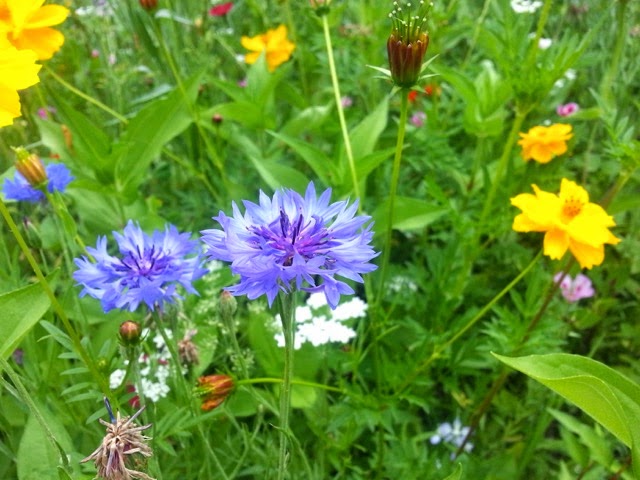

 That summer, many marigold and zinnia seeds germinated and flowered,
and the orchard was a riot of color for several months. The terrace
seeds also germinated and are now a perennial source of beauty and
pollen where in the past there was nothing but grass.
That summer, many marigold and zinnia seeds germinated and flowered,
and the orchard was a riot of color for several months. The terrace
seeds also germinated and are now a perennial source of beauty and
pollen where in the past there was nothing but grass.So how does planting flowers build community? I think there's a number of ways flowers add to a neighborhood. The first is it slows people down. I think that flowers can soften the hardest of hearts and slow down the fastest drivers, even if for a brief glance upon their soft and delicate aspect.
I think planting flowers shows passersby that this is a place where the owner respects not only the soil but the neighborhood, the bees and all other things that benefit from beauty. Is it possible that it's more difficult to throw trash among flowers than upon bare soil or a gravel lot?
Flowers, or anything beautiful for that matter, offer something to talk about. "What is that flower?," or "Have you smelled of this one?" I think children are innately curious about the beauty of flowers and we can all (re)learn to stop and smell them once in a while.
Flowers also add diversity to the landscape, in my case, breaking up patch after patch of mown grass, adding some height, some color, some scent, home to insects and refuge for birds.
But most of all, I think flowers offers refuge for the human mind to land on and pause and wonder, for just a moment, at the beauty of a plant that comes from a seed to become a flower for all to enjoy, even if just for that moment it's looked at.


Monday, April 20, 2015
Spring flowers in the orchard
This will be the third summer but only the second spring for our
front-yard orchard. Since it was built in late April, none of the
springtime ephemeral flowers had been planted yet.
 |
| We have three varieties of daffodil, known to me as early, mid and late season. |
 |
| The contorted flowering quince has thus far only contorted, but it looks like this year it's going to flower too! |
 |
| Go on, bend down and smell the flowers! |
 |
| I don't recall what this dainty flower with ferny leaves is called. |
 |
| There are also buds on the trees and the rhubarb is coming up. |
House to wrent on Madison's Eastside
NEW CONSTRUCTION - be the first to live in this cozy one-bedroom house located in the middle of a private orchard. Looking to rent to a bachelor wren seeking a safe place for this spring's prospective family.
House is sunny, dry, and made of western cedar (no moths eating your sweaters!) The fortified entry ensures no other birds get in; you can safely raise a family in this secure house.
The entry is oriented to protect you and your family from western wind and rain, and has a bird's eye view of the cherry tree.
Included are all-you-can-eat insect buffet, annual cleaning service, WiFi, water, sewer and protection from cats and other predators. If you really like the Nature Channel, we can add cable on request, but you'll have to pay for the hookup.
No smoking or fruit-eating.
Rent is a barter; free housing in exchange for protecting neighboring fruit trees from other birds.
.jpg)
House is sunny, dry, and made of western cedar (no moths eating your sweaters!) The fortified entry ensures no other birds get in; you can safely raise a family in this secure house.
The entry is oriented to protect you and your family from western wind and rain, and has a bird's eye view of the cherry tree.
Included are all-you-can-eat insect buffet, annual cleaning service, WiFi, water, sewer and protection from cats and other predators. If you really like the Nature Channel, we can add cable on request, but you'll have to pay for the hookup.
No smoking or fruit-eating.
Rent is a barter; free housing in exchange for protecting neighboring fruit trees from other birds.
Wednesday, April 15, 2015
Wren house installed
This weekend I installed a wren house in the center of our front-yard orchard. Any idea why a wren house in particular?
Wrens are insectivores, they only eat insects. Good for me, and good for my orchard trees and shrubs.
AND
Wrens are very territorial. That means they don't like other (fruit-eating) birds in the neighborhood. This is also good for me, because I might have a chance of getting a cherry or a honeyberry.
I bought this cute house at the 2015 Wisconsin Garden Expo, and the "post" is from one of the cyprus trees that we had removed from the front yard before we installed the orchard.

Wrens are insectivores, they only eat insects. Good for me, and good for my orchard trees and shrubs.
AND
Wrens are very territorial. That means they don't like other (fruit-eating) birds in the neighborhood. This is also good for me, because I might have a chance of getting a cherry or a honeyberry.
I bought this cute house at the 2015 Wisconsin Garden Expo, and the "post" is from one of the cyprus trees that we had removed from the front yard before we installed the orchard.
Wednesday, April 8, 2015
Mad City Coop tour
June 6, 9 a.m. - 1 p.m., self guided chicken coop tour.
Use this map to find unique, colorful and fun coops, and lots of ideas, including The Egg Plant at 1933 E. Mifflin St.
https://www.google.com/maps/d/viewer?mid=zF8oLCyKOlMY.kTids8GDV3jA
Use this map to find unique, colorful and fun coops, and lots of ideas, including The Egg Plant at 1933 E. Mifflin St.
https://www.google.com/maps/d/viewer?mid=zF8oLCyKOlMY.kTids8GDV3jA
Tuesday, April 7, 2015
Compost bin and rain barrel sale May 9
For my Madison-area gardeners
The annual home compost bin and rain barrel sale will take place on Saturday May 9th. Take advantage of this exclusive offer and get $10 off if you preorder by April 27th. Spring is almost here - and that means it's time to quench your thirst for gardening at the City of Madison Compost Bin And Rain Barrel Sale. This year's event will take place on Saturday, May 9th at the Alliant Energy Center parking lot. Pre-order online before April 27th and save an additional $10 off and pay no shipping. *This event is open to both Madison residents and non-residents. For more information and to pre-order visit: http://www.cityofmadison.com/
My take on composting
I do composting on a big scale - in autumn, I collect curbside leaves, grind them up and mix them with coffee grounds and let them cook for six months to make great compost and mulch. I also participate in Madison's "black bin" curbside compost recycling for weeds and foodstuff we can't compost like Brussels sprout stalks, and things the chickens shouldn't eat.
BUT I think there is a place in our garden for one of the smallish black composters on sale for winter composting and what chickens can't eat (potato skins, moldy food) that take longer than my leaf/coffee ground bins. I'm wondering if this would eliminate our need for the black bin...
... but what would I do with those Brussels sprout and kale stalks?
The annual home compost bin and rain barrel sale will take place on Saturday May 9th. Take advantage of this exclusive offer and get $10 off if you preorder by April 27th. Spring is almost here - and that means it's time to quench your thirst for gardening at the City of Madison Compost Bin And Rain Barrel Sale. This year's event will take place on Saturday, May 9th at the Alliant Energy Center parking lot. Pre-order online before April 27th and save an additional $10 off and pay no shipping. *This event is open to both Madison residents and non-residents. For more information and to pre-order visit: http://www.cityofmadison.com/
My take on composting
I do composting on a big scale - in autumn, I collect curbside leaves, grind them up and mix them with coffee grounds and let them cook for six months to make great compost and mulch. I also participate in Madison's "black bin" curbside compost recycling for weeds and foodstuff we can't compost like Brussels sprout stalks, and things the chickens shouldn't eat.
BUT I think there is a place in our garden for one of the smallish black composters on sale for winter composting and what chickens can't eat (potato skins, moldy food) that take longer than my leaf/coffee ground bins. I'm wondering if this would eliminate our need for the black bin...
... but what would I do with those Brussels sprout and kale stalks?
Subscribe to:
Posts (Atom)